Mecanum · ซอฟต์แวร์ระบุพารามิเตอร์วัสดุMecanum · Material parameter identification

FOAM-X: เปลี่ยนผลวัดในท่ออิมพีแดนซ์ให้เป็นพารามิเตอร์วัสดุFOAM-X: from impedance-tube data to material parameters

FOAM-X ของ Mecanum ใช้วิธี inverse characterization แปลงผลวัดจากท่ออิมพีแดนซ์ (impedance tube) ให้เป็นพารามิเตอร์ทางกายภาพของวัสดุรูพรุน วัสดุเส้นใย แผ่นเจาะรู และผ้า เพื่อนำไปใช้ในแบบจำลองและงานจำลองเสียงต่อ หน้านี้อธิบายว่า FOAM-X ตอบคำถามอะไร ทำงานอย่างไร ใช้แบบจำลองวัสดุแบบใด และเชื่อมกับเครื่องมือวัดและ NOVA อย่างไรMecanum FOAM-X uses inverse characterization to turn impedance-tube measurements into physical parameters of porous, fibrous, perforated and fabric materials, ready for modelling and simulation. This page explains which question FOAM-X answers, how it works, which material models it uses and how it connects with the measuring instruments and NOVA.

ภาพหน้าจอทางการของ Mecanum แสดงชื่อ “FOAM-X 2024” ในแถบชื่อหน้าต่างMecanum's official screenshots show “FOAM-X 2024” in the window title.

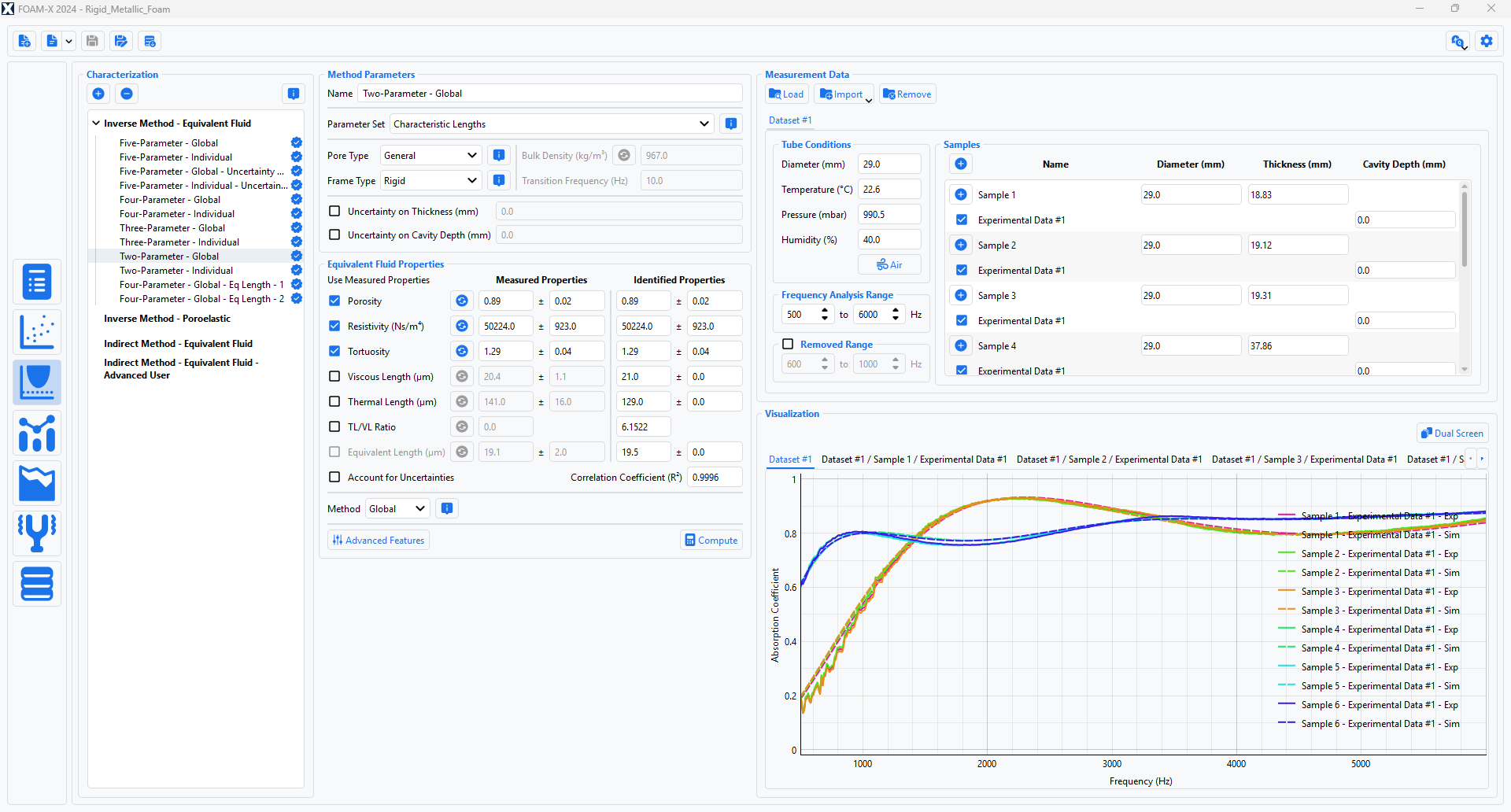
หน้าจอโมดูล Characterization ของ FOAM-X: รายการวิธี inverse ด้านซ้าย ตารางค่าที่วัดได้และค่าที่ระบุได้ตรงกลาง ข้อมูลตัวอย่างและสภาพการวัดในท่อด้านขวาบน และกราฟสัมประสิทธิ์การดูดซับเสียงของผลวัดเทียบผลจำลองด้านขวาล่างFOAM-X Characterization module: list of inverse methods on the left, measured and identified properties in the middle, samples and tube conditions top right, and measured versus simulated absorption curves bottom right
โมดูล Characterization ของ FOAM-X: ในตัวอย่างนี้ ค่า porosity, resistivity และ tortuosity ถูกวัดมาแล้วและตรึงไว้ โปรแกรมจึงหาเฉพาะ viscous length และ thermal length (ชุด Two-Parameter) จากตัวอย่าง 6 ชิ้นในท่อขนาด 29 มม. กราฟขวาล่างซ้อนเส้นผลวัด (Exp) กับผลจำลอง (Sim) ซึ่งเป็นวิธีตรวจว่าผลการหาค่าเชื่อถือได้หรือไม่ คลิกเพื่อดูภาพขนาดเต็มFOAM-X Characterization module: in this example porosity, resistivity and tortuosity were measured beforehand and fixed, so the software identifies only the viscous and thermal lengths (Two-Parameter set) from 6 samples in a 29 mm tube. The lower-right graph overlays measured (Exp) and simulated (Sim) curves, which is how you check whether the fit can be trusted. Click to view full size ภาพ: MecanumImage: Mecanum

Mecanum ระบุชื่อ Get Best Solutions Company Ltd. เป็นตัวแทนจำหน่าย (distributor) สำหรับประเทศไทย ในรายชื่อตัวแทนบนหน้า About us ของ Mecanum FOAM-X เป็นผลิตภัณฑ์ของ Mecanum Inc. (แคนาดา)Mecanum's distributor list on its About us page names Get Best Solutions Company Ltd. as its distributor for Thailand. FOAM-X is a product of Mecanum Inc. (Canada).

ภาพรวมOverview

FOAM-X คืออะไร?What is FOAM-X?

FOAM-X คืออะไร?What is FOAM-X?

FOAM-X คือซอฟต์แวร์ของ Mecanum สำหรับ ระบุพารามิเตอร์วัสดุ (parameter identification) ด้วยวิธี inverse characterization โปรแกรมรับผลวัดจากท่ออิมพีแดนซ์ แล้วหาค่าพารามิเตอร์ของแบบจำลองวัสดุ เช่น JCA, JCAL หรือ Biot ที่ทำให้ผลคำนวณตรงกับผลวัดมากที่สุด ค่าที่ได้นำไปใช้ในซอฟต์แวร์จำลองต่อ เช่น NOVA, VA One, COMSOL หรือ Hexagon ได้ตามที่ Mecanum ระบุFOAM-X is Mecanum's software for parameter identification by inverse characterization. It takes impedance-tube measurements and finds the parameters of a material model, such as JCA, JCAL or Biot, that make the calculated result match the measurement as closely as possible. According to Mecanum, the parameters can then be used in simulation software such as NOVA, VA One, COMSOL or Hexagon.

Mecanum ระบุว่า FOAM-X ใช้กับวัสดุ รูพรุน (porous) เส้นใย (fibrous) แผ่นเจาะรู (perforated) และผ้า (fabric) มีแบบจำลอง JCA, JCA-Lafarge (JCAL) และ Biot แบบ poroelastic เต็มรูปแบบ รวมถึงแบบจำลองเฉพาะสำหรับแผ่นเจาะรูและผ้า นอกจากการหาค่าแล้ว โปรแกรมยังประเมินความไม่แน่นอนของค่าที่ได้ (uncertainty quantification) และวิเคราะห์ความไวของผลต่อพารามิเตอร์แต่ละตัวตามความถี่ (sensitivity analysis) ได้ด้วยMecanum states that FOAM-X works with porous, fibrous, perforated and fabric materials, with the JCA, JCA-Lafarge (JCAL) and full Biot poroelastic models plus dedicated models for perforated plates and fabrics. Beyond identification, it estimates the uncertainty of the identified values (uncertainty quantification) and analyses how sensitive the result is to each parameter across frequency (sensitivity analysis).

คำถามที่ FOAM-X ช่วยตอบThe question FOAM-X answers

“มีตัวอย่างวัสดุรูพรุนอยู่ในมือ จะได้ค่าที่ใช้ออกแบบต่อได้อย่างไร?”“I have a porous sample: how do I get parameters I can design with?”

ท่ออิมพีแดนซ์บอกว่าตัวอย่าง ชิ้นนั้น ที่ความหนานั้น ดูดซับเสียงเท่าไร แต่งานพัฒนาวัสดุมักต้องการมากกว่านั้นAn impedance tube tells you how much that sample, at that thickness absorbs. Material development usually needs more than that.

  • อยากรู้ว่าวัสดุเดียวกันที่ ความหนาอื่น หรือ มีช่องอากาศด้านหลัง จะดูดซับเสียงอย่างไร โดยไม่ต้องตัดตัวอย่างใหม่ทุกกรณีYou want to know how the same material performs at another thickness or with an air gap behind it, without cutting a new sample for every case
  • อยากนำวัสดุไปใส่ใน แบบจำลองวัสดุหลายชั้น หรือโปรแกรม FEM/SEA ซึ่งต้องการพารามิเตอร์ทางกายภาพ ไม่ใช่แค่กราฟ αYou want to put the material into a multilayer model or an FEM/SEA program, which needs physical parameters, not just an α curve
  • อยากเปรียบเทียบสูตรวัสดุหลายแบบด้วยค่าที่มีความหมายทางกายภาพ เช่น airflow resistivity หรือ tortuosityYou want to compare material formulations with physically meaningful values such as airflow resistivity or tortuosity
  • อยากรู้ว่าพารามิเตอร์ตัวไหนมีผลต่อการดูดซับเสียงมากที่สุด ในย่านความถี่ที่สนใจYou want to know which parameter matters most for absorption in the frequency range you care about

ระบบนิเวศการทดสอบวัสดุของ Mecanum: FOAM-X อยู่ที่ขั้น CHARACTERIZEThe Mecanum material-testing ecosystem: FOAM-X sits at CHARACTERIZE

  1. 1MATERIALตัวอย่างวัสดุที่พัฒนาหรือเลือกใช้The sample you develop or select
  2. 2MEASUREวัดในท่ออิมพีแดนซ์ และวัดค่าโดยตรง เช่น airflow resistivityMeasure in the impedance tube, plus direct values such as airflow resistivityImpedance tube · Airflow meter
  3. 3CHARACTERIZEหาพารามิเตอร์ของแบบจำลองวัสดุIdentify the material-model parametersFOAM-X
  4. 4MODELใช้พารามิเตอร์ในแบบจำลองวัสดุหลายชั้นUse the parameters in a multilayer modelNOVA
  5. 5ANALYZEดูความไว ความไม่แน่นอน และเทียบกับผลวัดCheck sensitivity, uncertainty and agreement with measurementFOAM-X · NOVA
  6. 6OPTIMIZEปรับชั้นวัสดุและความหนาก่อนสร้างจริงAdjust layers and thicknesses before buildingNOVA

แผนผังแนวคิดตามการเชื่อมโยงที่ Mecanum อธิบายไว้ในหน้าผลิตภัณฑ์ (วัด → ระบุพารามิเตอร์ → จำลองวัสดุหลายชั้น → เทียบกับผลวัด) ดูภาพรวมทั้งระบบได้ที่ Mecanum ระบบทดสอบวัสดุอะคูสติกConceptual chain following the links Mecanum describes on its product pages (measure → identify parameters → simulate the multilayer → compare with measurement). See the whole system on Mecanum acoustic material testing

พื้นฐานBasics

การวัดคุณลักษณะวัสดุอะคูสติกคืออะไร?What is acoustic material characterization?

การวัดคุณลักษณะวัสดุอะคูสติก (acoustic material characterization) คืออะไร?What is acoustic material characterization?

คือการหาค่าทางกายภาพที่อธิบายว่าเสียงเดินทางและสูญเสียพลังงานในวัสดุอย่างไร เช่น สัดส่วนช่องว่าง (porosity) ความต้านทานการไหลของอากาศ (airflow resistivity) และความคดเคี้ยวของรูพรุน (tortuosity) เมื่อรู้ค่าเหล่านี้ เราคำนวณพฤติกรรมของวัสดุในสถานการณ์อื่นได้ ไม่ต้องวัดใหม่ทุกครั้งIt means finding the physical values that describe how sound travels and loses energy inside a material, such as porosity, airflow resistivity and tortuosity. Once these are known, the material's behaviour can be calculated for other situations instead of being measured again every time.

วิธีวัดตรง (direct)Direct method
วัดพารามิเตอร์แต่ละตัวด้วยเครื่องมือเฉพาะ เช่น วัด airflow resistivity ด้วย เครื่องวัดความต้านทานการไหลของอากาศ Mecanum มีเครื่องมือวัดตรงสำหรับ porosity, tortuosity และค่าทางกลของโครงวัสดุด้วยEach parameter is measured with a dedicated instrument, for example airflow resistivity with an airflow resistance meter. Mecanum also makes direct instruments for porosity, tortuosity and the mechanical properties of the frame
วิธีย้อนกลับ (inverse)Inverse method
หาพารามิเตอร์ที่ทำให้ผลคำนวณจากแบบจำลองตรงกับเส้นโค้งที่วัดได้จากท่ออิมพีแดนซ์มากที่สุด ใช้เครื่องมือน้อยกว่า แต่ต้องตรวจความน่าเชื่อถือของผลเสมอFind the parameters that make the model's calculation best match the curve measured in the impedance tube. It needs fewer instruments, but the result must always be checked for reliability
วิธีผสมCombined approach
วัดค่าที่วัดตรงได้ก่อน แล้วตรึงค่าเหล่านั้นไว้ระหว่างการหาค่าแบบย้อนกลับ Mecanum อธิบายว่าบริการวัดคุณลักษณะวัสดุของตนใช้วิธีตรงร่วมกับวิธีย้อนกลับ และ FOAM-X ให้ตรึงค่าที่รู้แล้วได้Measure what can be measured directly, then fix those values during the inverse fit. Mecanum describes its own characterization service as combining direct and inverse methods, and FOAM-X lets known values be fixed

อธิบายจากพื้นฐานถึงระดับวิศวกรFrom beginner to engineer

Inverse characterization คืออะไร?What is inverse characterization?

Inverse characterization คืออะไร?What is inverse characterization?

ปกติเราใช้แบบจำลองคำนวณ จากพารามิเตอร์ไปหาผลลัพธ์ เช่น รู้ค่า porosity และ airflow resistivity แล้วคำนวณค่าการดูดซับเสียง inverse characterization ทำ กลับทาง: เริ่มจากเส้นโค้งที่วัดได้ แล้วค้นหาชุดพารามิเตอร์ที่ทำให้แบบจำลองให้เส้นโค้งเดียวกัน เปรียบเหมือนการเดาสูตรอาหารจากการชิมรสชาติ แล้วปรับสูตรจนรสชาติตรงกับจานต้นแบบNormally a model runs from parameters to results: you know the porosity and airflow resistivity and calculate the absorption. Inverse characterization runs the other way: it starts from the measured curve and searches for the set of parameters that makes the model produce the same curve. It is like working out a recipe by tasting a dish, then adjusting the recipe until it tastes the same.

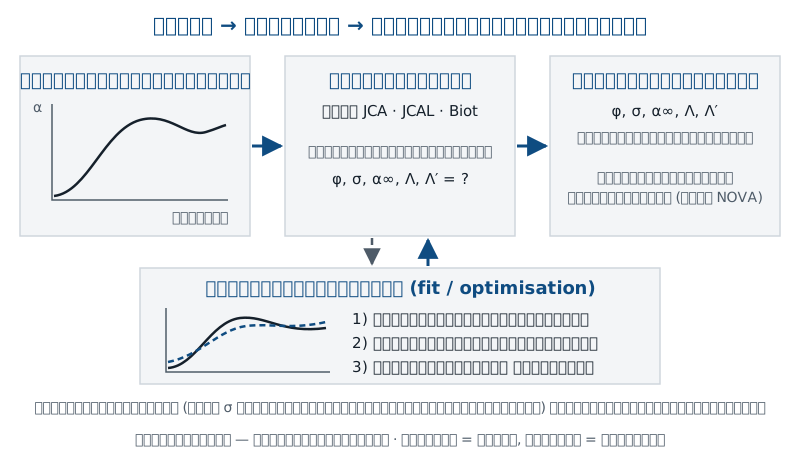
สามกล่องเรียงซ้ายไปขวา: ผลวัดจากท่ออิมพีแดนซ์ แบบจำลองวัสดุที่มีพารามิเตอร์ไม่ทราบค่า และพารามิเตอร์ที่ประมาณได้พร้อมช่วงความไม่แน่นอน ด้านล่างเป็นกล่องขั้นปรับให้เข้ากัน มีกราฟเส้นทึบผลวัดและเส้นประแบบจำลองThree boxes from left to right: impedance-tube data, a material model with unknown parameters, and estimated parameters with an uncertainty range. Below, a fit/optimisation box with a solid measured curve and a dashed model curve
หลักการของ inverse characterization: ผลวัดจากท่ออิมพีแดนซ์ถูกเทียบกับผลคำนวณจากแบบจำลองวัสดุซ้ำหลายรอบ โปรแกรมปรับพารามิเตอร์จนเส้นโค้งทั้งสองเข้ากันดีที่สุด ค่าที่วัดตรงได้ตรึงไว้เพื่อลดจำนวนค่าที่ต้องค้นหาThe principle of inverse characterization: the impedance-tube result is compared with the material model's calculation over and over, and the parameters are adjusted until the two curves agree best. Values measured directly can be fixed to reduce the number of unknowns

ทำไมไม่วัดทุกค่าโดยตรง? เพราะพารามิเตอร์บางตัว เช่น characteristic length วัดตรงได้ยากและต้องใช้เครื่องมือเฉพาะ การหาค่าแบบย้อนกลับจากผลวัดในท่อจึงช่วยให้ได้ชุดพารามิเตอร์ครบจากการวัดที่ทำได้จริงในห้องปฏิบัติการ ข้อควรระวังคือ พารามิเตอร์หลายชุดอาจให้เส้นโค้งใกล้เคียงกัน ผลที่ดีจึงต้องมีทั้งเส้นโค้งที่เข้ากัน ค่าที่สมเหตุสมผลทางกายภาพ และช่วงความไม่แน่นอนที่แคบพอWhy not measure every value directly? Some parameters, such as the characteristic lengths, are hard to measure directly and need specialised instruments. Identifying them from tube data gives a complete parameter set from measurements a laboratory can actually make. The catch is that several parameter sets can produce similar curves, so a good result needs a curve that matches, values that make physical sense and an uncertainty range that is narrow enough.

สำหรับวิศวกร: การหาค่าที่เหมาะที่สุด ความไม่เป็นเอกลักษณ์ และสิ่งที่ช่วยให้ผลเชื่อถือได้For engineers: optimisation, non-uniqueness and what makes the result reliable

ในเชิงคณิตศาสตร์ inverse characterization คือปัญหาการหาค่าที่เหมาะที่สุด (optimisation) รูปแบบทั่วไปที่ใช้อธิบายแนวคิดคือการหาชุดพารามิเตอร์ p ที่ทำให้ผลต่างระหว่างผลวัดกับผลจำลองรวมทุกความถี่มีค่าน้อยที่สุด สมการด้านล่างเป็นรูปแบบแนวคิดทั่วไป ไม่ใช่สูตรที่ FOAM-X ใช้จริง ซึ่ง Mecanum ไม่ได้เผยแพร่รายละเอียดMathematically, inverse characterization is an optimisation problem. A common way to express the idea is to find the parameter set p that minimises the difference between measurement and simulation summed over frequency. The equation below is a generic conceptual form, not FOAM-X's actual formulation, which Mecanum does not publish.

min over p : Σ_f | α_meas(f) − α_model(f; p) |²

p
ชุดพารามิเตอร์ที่ค้นหา เช่น φ, σ, α∞, Λ, Λ′ (ไม่มีหน่วยรวม แต่ละตัวมีหน่วยของตัวเอง ดูตารางด้านล่าง)the parameter set being searched, e.g. φ, σ, α∞, Λ, Λ′ (each with its own unit, see the table below)
α_meas(f)
ค่าสัมประสิทธิ์การดูดซับเสียงที่วัดได้ที่ความถี่ f (ไม่มีหน่วย 0–1)measured absorption coefficient at frequency f (dimensionless, 0–1)
α_model(f; p)
ค่าที่แบบจำลองคำนวณได้ที่ความถี่ f จากพารามิเตอร์ p (ไม่มีหน่วย)absorption calculated by the model at frequency f from parameters p (dimensionless)
f
ความถี่ภายในย่านที่เลือกวิเคราะห์ (Hz)frequency within the chosen analysis range (Hz)
  • อัลกอริทึม: หน้าบริการวัดคุณลักษณะวัสดุ JCAL/Biot ของ Mecanum ระบุว่าใช้ genetic algorithm ปรับพารามิเตอร์ให้เข้ากับเส้นโค้งที่วัดในท่อAlgorithm: Mecanum's JCAL/Biot characterization service page says a genetic algorithm fits the parameters to the measured tube curve
  • ข้อมูลหลายชุด: Mecanum ระบุว่า FOAM-X รวมข้อมูลจากท่อหลายชนิดหรือหลายรูปแบบได้ ในภาพหน้าจอมีตัวอย่าง 6 ชิ้นในโครงการเดียว และเลือกได้ระหว่างการหาค่าแบบ Global และ IndividualSeveral datasets: Mecanum says FOAM-X can combine data from several tube types or geometries; the screenshot shows 6 samples in one project and a choice between Global and Individual identification
  • ตรึงค่าที่รู้แล้ว: ลดจำนวนตัวแปรที่ต้องค้นหา ช่วยให้ผลมีเอกลักษณ์มากขึ้น ในภาพหน้าจอหลัก ค่า porosity, resistivity และ tortuosity ถูกตรึงไว้ แล้วหาเฉพาะ characteristic length สองตัวFix known values: fewer unknowns make the answer more unique. In the main screenshot porosity, resistivity and tortuosity are fixed and only the two characteristic lengths are identified
  • ความไม่แน่นอนและความไว: ค่าที่ได้ควรอ่านพร้อมช่วงความไม่แน่นอน และดูว่าพารามิเตอร์ใดมีผลน้อยในย่านที่วัด ค่านั้นมักหาได้ไม่แม่นUncertainty and sensitivity: read each value with its uncertainty range, and check which parameters have little influence in the measured range: those are usually poorly determined
  • Indirect method: ภาพหน้าจอแสดงหมวด “Indirect Method – Equivalent Fluid” ด้วย ในงานวิชาการ คำว่า indirect มักหมายถึงการคำนวณพารามิเตอร์เชิงวิเคราะห์จาก dynamic density และ bulk modulus ที่วัดได้ (ค่าที่ท่อแบบ 3 ไมโครโฟนให้ได้) แทนการปรับเส้นโค้ง Mecanum ไม่ได้อธิบายรายละเอียดของวิธีนี้ใน FOAM-XIndirect method: the screenshot also shows an “Indirect Method – Equivalent Fluid” group. In the literature, indirect usually means calculating the parameters analytically from the measured dynamic density and bulk modulus (which the 3-microphone tube method provides) rather than curve fitting. Mecanum does not describe FOAM-X's version in detail

ขั้นตอนการทำงานWorkflow

จากตัวอย่างวัสดุถึงพารามิเตอร์ที่ใช้งานได้From sample to usable parameters

ขั้นตอนด้านล่างเรียบเรียงจากสิ่งที่ Mecanum ระบุไว้ในหน้า FOAM-X, ท่ออิมพีแดนซ์ และบริการวัดคุณลักษณะวัสดุThe steps below follow what Mecanum states on its FOAM-X, impedance-tube and characterization-service pages.

  1. 1วัดตัวอย่างในท่อMeasure the sampleวัดค่าการดูดซับและอิมพีแดนซ์ในท่ออิมพีแดนซ์Measure absorption and impedance in the impedance tubeImpedance tube · Tube-X
  2. 2นำเข้าข้อมูลImport the dataโหลดโครงการจากท่อ วางข้อมูลจาก Excel หรือรวมหลายชุดข้อมูลLoad tube projects, paste from Excel or combine datasetsFOAM-X
  3. 3เลือกแบบจำลองและตรึงค่าที่รู้Choose model, fix known valuesเช่น ตรึง σ ที่วัดด้วยเครื่องวัดการไหลของอากาศe.g. fix σ measured with the airflow meterFOAM-X
  4. 4หาค่าแบบย้อนกลับInverse characterizationปรับพารามิเตอร์ให้ผลจำลองตรงกับผลวัดFit the parameters so simulation matches measurementFOAM-X
  5. 5ตรวจความไม่แน่นอนและความไวCheck uncertainty and sensitivityดูช่วงของค่าที่ได้ และพารามิเตอร์ที่มีผลในแต่ละย่านความถี่Look at the value ranges and which parameters matter at each frequencyFOAM-X
  6. 6ใช้พารามิเตอร์ต่อUse the parametersส่งออกไปยัง NOVA, VA One, COMSOL หรือ HexagonExport to NOVA, VA One, COMSOL or HexagonNOVA · อื่น ๆNOVA · others

Mecanum ไม่ได้ระบุรูปแบบไฟล์ที่ใช้แลกเปลี่ยนข้อมูล และไม่ได้ระบุว่าการส่งข้อมูลระหว่างโปรแกรมทำได้ในคลิกเดียว จึงไม่ได้กล่าวถึงในที่นี้Mecanum does not state the file formats used for the exchange, or whether the transfer between programs is one click, so neither is described here.

คู่มือเริ่มต้นใช้งานBeginner Guide

คู่มือเริ่มต้นใช้งาน FOAM-X: ระบุพารามิเตอร์ของวัสดุพรุนชิ้นแรกFOAM-X Beginner Guide: identify your first porous material

Mecanum ยังไม่เผยแพร่คู่มือผู้ใช้ FOAM-X ต่อสาธารณะ ชื่อหน้าต่างและปุ่มในคู่มือนี้อ่านจากวิดีโอสาธิตทางการของ Mecanum (FOAM-X 2025) และอาจเปลี่ยนตามเวอร์ชันMecanum has not published a public FOAM-X user manual. Window and button names in this guide are read from Mecanum's official demo video (FOAM-X 2025) and may change between versions.

ต้องมีอะไรบ้างก่อนเริ่มWhat you need before you start

  • ผลวัดจากท่ออิมพีแดนซ์ตาม ISO 10534-2 / ASTM E1050 ในวิดีโอสาธิต ตัวอย่างสักหลาด 11 mm วัดหลายแบบ: วางชิดผนังแข็ง และมีช่องอากาศด้านหลังสองระยะImpedance-tube measurements to ISO 10534-2 / ASTM E1050. In the demo, an 11 mm felt was measured in several configurations: against a hard wall and with two air gaps behind it.
  • ข้อมูลการวัด: เส้นผ่านศูนย์กลางท่อ อุณหภูมิ ความดัน ความชื้น และความหนาของตัวอย่างกับระยะช่องอากาศแต่ละแบบThe test conditions: tube diameter, temperature, pressure, humidity, and each sample's thickness and cavity depth.
  • ถ้ามี ค่าที่วัดตรงได้ เช่น airflow resistivity (เครื่อง SIGMA ตาม ISO 9053 / ASTM C522) porosity หรือ tortuosity ซึ่งช่วยให้ผลแม่นขึ้นIf available, directly measured values such as airflow resistivity (SIGMA meter, ISO 9053 / ASTM C522), porosity or tortuosity, which make the result more precise.
  • พื้นฐาน: การสะท้อน การดูดซับ และการส่งผ่านเสียงBackground: reflection, absorption and transmission.
  1. STEP1

    วัดตัวอย่างในท่ออิมพีแดนซ์ให้ดีก่อนMeasure the sample well in the impedance tube

    ผลของ FOAM-X ดีได้เท่าข้อมูลที่ใส่ Mecanum ระบุว่าตัวอย่างที่เล็กเกินไปจะมีรอยรั่วและอาจทำให้การดูดซับสูงเกินจริง ส่วนตัวอย่างที่ใหญ่เกินไปจะถูกบีบจนเกิดการสั่นทางกลที่บิดเบือนผล ใช้ใบมีดตัดที่คมเพื่อให้ขอบตัวอย่างเรียบ และบันทึกสภาพการวัดทุกครั้งFOAM-X is only as good as its input. Mecanum notes that a sample that is too small leaks and can overstate absorption, while one that is too large is compressed and mechanical resonances distort the result. Use a sharp cutter for clean edges and record the test conditions every time.

  2. STEP2

    สร้างโปรเจกต์และเลือกวิธี characterizationCreate a project and choose a characterization method

    สร้างโปรเจกต์ใหม่ แล้วในแผง Characterization เลือกวิธี มีสี่แบบ: Inverse Method แบบ Equivalent Fluid, Inverse Method แบบ Poroelastic (Biot ซึ่งหาค่าเชิงกลด้วย) และ Indirect Method สองแบบ กด + เพื่อเพิ่มรายการ characterization ของตัวอย่าง วิดีโอสาธิตใช้ Inverse Method - Equivalent FluidCreate a new project, then choose a method in the Characterization panel. There are four: Inverse Method - Equivalent Fluid, Inverse Method - Poroelastic (Biot, which also identifies the elastic properties) and two Indirect Method options. Press + to add a characterization for your sample; the demo uses Inverse Method - Equivalent Fluid.

    ในโปรแกรมIn the programแผง Characterization → Inverse Method - Equivalent Fluid / Inverse Method - Poroelastic / Indirect Method… → +Characterization panel → Inverse Method - Equivalent Fluid / Inverse Method - Poroelastic / Indirect Method… → +

  3. STEP3

    นำเข้าข้อมูลจากท่อImport the tube data

    นำเข้าข้อมูลจากคอมพิวเตอร์ (วิดีโอสาธิตเปิดโปรเจกต์ TUBE-X ของ Mecanum) หรือจาก AcoustaLink หน้าผลิตภัณฑ์ระบุว่าวางข้อมูลจาก Excel ได้ด้วย เลือกชุดข้อมูลที่จะใช้ fit เช่น การดูดซับเมื่อวางชิดผนังแข็งImport from your computer (the demo opens a Mecanum TUBE-X project) or from AcoustaLink; the product page says data can also be pasted from Excel. Choose the datasets to fit, for example the absorption against a hard wall.

    ในโปรแกรมIn the programMeasurement Data → Import → From Your Computer / From AcoustaLinkMeasurement Data → Import → From Your Computer / From AcoustaLink

  4. STEP4

    ตรวจสภาพการวัดและช่วงความถี่Check the test conditions and frequency range

    ตรวจค่าใน Tube Conditions (เส้นผ่านศูนย์กลาง อุณหภูมิ ความดัน ความชื้น) ตั้งช่วงความถี่ที่วิเคราะห์ ตัดย่านที่ไม่น่าเชื่อถือออกได้ และตรวจความหนากับระยะช่องอากาศของแต่ละตัวอย่างในตาราง SamplesCheck the Tube Conditions (diameter, temperature, pressure, humidity), set the analysed frequency range, remove an unreliable band if needed, and check each sample's thickness and cavity depth in the Samples table.

    ในโปรแกรมIn the programTube Conditions · Frequency Analysis Range · Removed Range · ตาราง Samples (Thickness, Cavity Depth)Tube Conditions · Frequency Analysis Range · Removed Range · Samples table (Thickness, Cavity Depth)
  5. STEP5

    ตั้งค่าแบบจำลองSet the model options

    ใน Method Parameters เลือก Pore Type (General หรือ Fiber) ซึ่งวิดีโอแนะนำให้ใช้ General เพื่อไม่ให้แบบจำลองถูกทำให้ง่ายเกินไป เลือก Frame Type (Rigid, Limp หรือ Hybrid) และติ๊กให้คิดความไม่แน่นอนของความหนาและระยะช่องอากาศได้In Method Parameters choose the Pore Type (General or Fiber; the demo advises General to avoid oversimplifying) and the Frame Type (Rigid, Limp or Hybrid), and optionally tick the uncertainty on thickness and cavity depth.

    ในโปรแกรมIn the programMethod Parameters → Pore Type, Frame Type, Uncertainty on Thickness / Cavity DepthMethod Parameters → Pore Type, Frame Type, Uncertainty on Thickness / Cavity Depth

  6. STEP6

    ใส่ค่าที่รู้แล้วEnter what you already know

    ถ้าวัดค่าบางตัวได้โดยตรง เช่น porosity หรือ resistivity ให้ติ๊ก Use Measured Properties แล้วใส่ค่าพร้อมความไม่แน่นอน วิดีโอระบุว่าช่วยให้การ inverse แม่นขึ้นIf you measured some values directly, such as porosity or resistivity, tick Use Measured Properties and enter them with their uncertainty; the demo notes this makes the inversion more precise.

    ในโปรแกรมIn the programEquivalent Fluid Properties → Use Measured Properties → Measured PropertiesEquivalent Fluid Properties → Use Measured Properties → Measured Properties

  7. STEP7

    คำนวณและตรวจความเข้ากันของผลCompute and check the fit

    กด Compute ผลจะแสดงใน Identified Properties เป็นค่าพร้อมความไม่แน่นอน และแสดงค่า Correlation Coefficient (R²) พร้อมเส้นที่จำลองซ้อนกับเส้นที่วัด ดูทั้ง R² และช่วงความไม่แน่นอนของแต่ละค่าPress Compute. The results appear under Identified Properties as values with uncertainty, with the Correlation Coefficient (R²) and the simulated curve over the measured one. Look at both R² and the uncertainty of each value.

    ในโปรแกรมIn the programCompute · Identified Properties · Correlation Coefficient (R²)Compute · Identified Properties · Correlation Coefficient (R²)

    ข้อควรระวังWatch outค่าที่ได้คือชุดพารามิเตอร์ที่ทำให้แบบจำลองตรงกับผลวัด ค่าที่มีความไม่แน่นอนสูงควรยืนยันด้วยการวัดตรงหรือการทดสอบอีกแบบThe result is a set of parameters that makes the model match the measurement; values with a large uncertainty should be confirmed by direct measurement or another test.

  8. STEP8

    ยืนยันกับข้อมูลที่ไม่ได้ใช้ fitValidate against data not used in the fit

    เปิดโมดูล Simulation เพิ่ม simulation เลือกชุดพารามิเตอร์ที่ได้ ใส่ความหนาและระยะช่องอากาศ แล้วเทียบกับผลวัดแบบที่ไม่ได้ใช้ตอน fit เช่น วิดีโอเทียบกับการวัดที่มีช่องอากาศ 30 mm ใช้ Lock/Unlock เก็บเส้นเดิมไว้เทียบOpen the Simulation module, add a simulation, pick the identified parameter set, enter the thickness and cavity depth, and compare with a measurement that was not used in the fit; the demo compares with a 30 mm air-gap measurement. Use Lock/Unlock to keep a curve for comparison.

    ในโปรแกรมIn the programSimulation Manager → Parameter Set Selection → Characterization → Cav. Depth → Compute · Lock/UnlockSimulation Manager → Parameter Set Selection → Characterization → Cav. Depth → Compute · Lock/Unlock

  9. STEP9

    ดูความไวของพารามิเตอร์และส่งออกCheck sensitivity and export

    FOAM-X มีการวิเคราะห์ความไวที่บอกว่าพารามิเตอร์ใดมีผลมากที่สุดในแต่ละความถี่ จากนั้นบันทึกหรือส่งออกพารามิเตอร์ไปใช้ต่อ Mecanum ระบุปลายทางคือ NOVA, VA One, COMSOL และ Hexagon รวมทั้งเก็บใน AcoustaLinkFOAM-X has a sensitivity analysis showing which parameters matter most at each frequency. Then save or export the parameters; Mecanum names NOVA, VA One, COMSOL and Hexagon as targets, as well as storage in AcoustaLink.

    ข้อควรระวังWatch outNOVA รับค่า viscous / thermal length เป็นเมตร ส่วน FOAM-X แสดงเป็นไมโครเมตร ตรวจหน่วยเมื่อคัดลอกค่าด้วยมือNOVA takes the viscous and thermal lengths in metres, while FOAM-X shows micrometres; check the units when copying values by hand.

ชื่อหน้าจอ รูปแบบไฟล์ส่งออก เวอร์ชัน และเงื่อนไขใบอนุญาตยังไม่มีเอกสารทางการเผยแพร่ ขั้นตอนนี้อ้างอิงหน้าผลิตภัณฑ์และวิดีโอสาธิตของ Mecanum เท่านั้นScreen names, export formats, the version and licence terms have no published official documentation; these steps rely only on Mecanum's product page and demo video.

ค่าที่ต้องอ่านให้เป็นValues to understand

พารามิเตอร์ที่ FOAM-X หาได้The parameters FOAM-X identifies

ความหมายตาม Learning Center ของ MecanumMeanings as in Mecanum's Learning Center.

Static airflow resistivity σ · N·s/m⁴

คืออะไรWhat it is
ความต้านทานต่อการไหลของอากาศแบบคงที่ต่อหน่วยความหนา วัดตาม ISO 9053 / ASTM C522The resistance to steady airflow per unit thickness, measured per ISO 9053 / ASTM C522.
ทำไมต้องสนใจWhy it matters
Mecanum เรียกว่าเป็นพารามิเตอร์ที่สำคัญมากในการจำลอง และใช้ควบคุมคุณภาพการผลิตได้Mecanum calls it a very important modelling parameter; it is also used for production quality control.
เข้าใจผิดบ่อยCommon misunderstanding
ไม่ใช่ค่าเดียวกับ airflow resistance หรือ specific airflow resistance ซึ่งไม่ได้หารด้วยความหนาIt is not the same as airflow resistance or specific airflow resistance, which are not normalised by thickness.

Open porosity φ · –

คืออะไรWhat it is
สัดส่วนปริมาตรของรูพรุนที่ต่อถึงกัน ไม่นับรูปิดThe volume fraction of interconnected pores; closed pores are excluded.
ทำไมต้องสนใจWhy it matters
เป็นข้อมูลหลักของแบบจำลอง JCA และ BiotA core input of the JCA and Biot models.
เข้าใจผิดบ่อยCommon misunderstanding
ไม่ใช่สัดส่วนช่องว่างทั้งหมด เซลล์ที่ปิดไม่นับIt is not the total void fraction: closed cells do not count.

Tortuosity α∞ · –

คืออะไรWhat it is
บอกว่าเส้นทางเสียงผ่านรูพรุนคดเคี้ยวต่างจากเส้นตรงแค่ไหน (มีค่าตั้งแต่ 1)How far the acoustic path through the pores departs from a straight line (1 or more).
ทำไมต้องสนใจWhy it matters
มีผลต่อพฤติกรรมเชิงแรงเฉื่อยในรูพรุนที่ความถี่สูงGoverns inertial effects in the pores at high frequencies.

Viscous และ thermal characteristic lengthViscous and thermal characteristic lengths Λ · Λ′ · µm

คืออะไรWhat it is
Λ ใกล้กับรัศมีเฉลี่ยของคอรูพรุนที่เล็ก Λ′ ใกล้กับรัศมีของรูพรุนที่ใหญ่ ค่า Λ′ ไม่น้อยกว่า ΛΛ relates to the average radius of the small pore necks, Λ′ to that of the larger pores; Λ′ is never smaller than Λ.
ทำไมต้องสนใจWhy it matters
กำหนดการสูญเสียจากความหนืดและความร้อนที่ความถี่สูงGovern viscous and thermal losses at high frequencies.
เข้าใจผิดบ่อยCommon misunderstanding
FOAM-X แสดงเป็นไมโครเมตร แต่ NOVA รับเป็นเมตรFOAM-X shows micrometres, but NOVA takes metres.

Static thermal permeability k0′ · m²

คืออะไรWhat it is
พารามิเตอร์เพิ่มเติมของแบบจำลอง JCAL (JCA-Lafarge)The extra parameter of the JCAL (JCA-Lafarge) model.
ทำไมต้องสนใจWhy it matters
ช่วยให้แบบจำลองพฤติกรรมเชิงความร้อนที่ความถี่ต่ำได้ดีขึ้นImproves the modelled thermal behaviour at low frequencies.
เข้าใจผิดบ่อยCommon misunderstanding
แบบจำลอง JCA ธรรมดาไม่ใช้ค่านี้The plain JCA model does not use it.

ค่าเชิงกลของโครงวัสดุFrame mechanical properties E · ν · η · Pa · – · –

คืออะไรWhat it is
Young's modulus, Poisson's ratio และค่าการหน่วง (loss factor) ของโครงวัสดุThe frame's Young's modulus, Poisson's ratio and loss factor.
ทำไมต้องสนใจWhy it matters
จำเป็นเมื่อโครงวัสดุสั่นได้ (แบบจำลอง Biot / poroelastic) และต่อการส่งผ่านเสียงNeeded when the frame can vibrate (Biot / poroelastic model) and for transmission.
เข้าใจผิดบ่อยCommon misunderstanding
ถ้าเลือก Frame Type เป็น Rigid ค่าเหล่านี้ไม่ได้ใช้With a Rigid frame type these are not used.

แบบจำลองวัสดุMaterial models

FOAM-X ใช้แบบจำลองวัสดุแบบใด?Which material models does FOAM-X use?

Mecanum ระบุแบบจำลอง JCA, JCAL และ Biot รวมถึงแบบจำลองเฉพาะสำหรับแผ่นเจาะรูและผ้า ตารางด้านล่างเป็นความรู้พื้นฐานทางอะคูสติกของแบบจำลองแต่ละกลุ่ม ไม่ใช่รายละเอียดการคำนวณภายใน FOAM-XMecanum lists the JCA, JCAL and Biot models plus dedicated perforated-plate and fabric models. The table below gives general acoustics background for each model family, not the internal implementation of FOAM-X.

แบบจำลองModelใช้กับวัสดุแบบใดMaterial typeข้อมูลหลักของแบบจำลองMain inputsทำนายอะไรWhat it predictsสมมติฐานสำคัญKey assumption
JCA (Johnson-Champoux-Allard)JCA (Johnson-Champoux-Allard)ใช้กับวัสดุแบบใดMaterial typeโฟมเซลล์เปิดและวัสดุเส้นใยที่โครงแข็งหรือเคลื่อนที่น้อยOpen-cell foams and fibrous materials whose frame is rigid or barely movesข้อมูลหลักของแบบจำลองMain inputs5 ค่า: φ, σ, α∞, Λ, Λ′5 values: φ, σ, α∞, Λ, Λ′ทำนายอะไรWhat it predictsความหนาแน่นและ bulk modulus เชิงพลวัตของอากาศในรูพรุน จึงคำนวณการดูดซับและอิมพีแดนซ์ผิวได้The dynamic density and bulk modulus of the air in the pores, hence absorption and surface impedanceสมมติฐานสำคัญKey assumptionมองวัสดุเป็น ของไหลเทียบเท่า (equivalent fluid) โครงไม่สั่นTreats the material as an equivalent fluid; the frame does not move
JCAL (JCA-Lafarge)JCAL (JCA-Lafarge)ใช้กับวัสดุแบบใดMaterial typeเหมือน JCA แต่ต้องการความแม่นยำด้านผลทางความร้อนที่ความถี่ต่ำมากขึ้นAs JCA, when thermal effects at low frequency need more accuracyข้อมูลหลักของแบบจำลองMain inputs6 ค่า: JCA + k0′6 values: JCA + k0′ทำนายอะไรWhat it predictsเช่นเดียวกับ JCA โดยอธิบายการแลกเปลี่ยนความร้อนได้ละเอียดขึ้นAs JCA, with a finer description of heat exchangeสมมติฐานสำคัญKey assumptionของไหลเทียบเท่า โครงไม่สั่นEquivalent fluid; the frame does not move
Biot (poroelastic)Biot (poroelastic)ใช้กับวัสดุแบบใดMaterial typeวัสดุรูพรุนที่โครงสั่นได้และมีผลต่อเสียง เช่น เมื่อติดกับแผ่นที่สั่นPorous materials whose frame vibrates and affects the sound, e.g. when bonded to a vibrating panelข้อมูลหลักของแบบจำลองMain inputsค่าของไหล (แบบ JCA/JCAL) + ความหนาแน่นโครง E, ν, ηFluid values (JCA/JCAL) + frame density, E, ν, ηทำนายอะไรWhat it predictsคลื่นทั้งในอากาศและในโครงวัสดุ ทั้งการดูดซับและการส่งผ่านเสียงWaves in both the air and the frame, for absorption and transmissionสมมติฐานสำคัญKey assumptionโครงเป็นของแข็งยืดหยุ่น เชื่อมกับอากาศในรูพรุนThe frame is an elastic solid coupled to the pore air
แผ่นเจาะรู (perforated plate)Perforated plateใช้กับวัสดุแบบใดMaterial typeแผ่นโลหะ ไม้ หรือแผ่นอื่นที่เจาะรู มักใช้คู่กับช่องอากาศหรือวัสดุรูพรุนMetal, wood or other plates with holes, often combined with an air gap or porous layerข้อมูลหลักของแบบจำลองMain inputsโดยทั่วไป: ความหนาแผ่น ขนาดรู และสัดส่วนพื้นที่รูTypically: plate thickness, hole size and open-area ratioทำนายอะไรWhat it predictsอิมพีแดนซ์ของแผ่น ซึ่งใช้คำนวณการดูดซับของชุดแผ่นกับชั้นด้านหลังThe plate impedance, used to calculate absorption of the plate with what is behind itสมมติฐานสำคัญKey assumptionรูเล็กกว่าความยาวคลื่นมาก Mecanum ไม่ได้เผยแพร่ข้อมูลเข้าของแบบจำลองนี้Holes much smaller than the wavelength. Mecanum does not publish this model's inputs
ผ้า (fabric)Fabricใช้กับวัสดุแบบใดMaterial typeผ้าและชั้นบางที่ต้านการไหลของอากาศ เช่น ผ้าหุ้มหรือแผ่นใยบางFabrics and thin air-resistive layers such as facings or scrimsข้อมูลหลักของแบบจำลองMain inputsโดยทั่วไป: ความต้านทานการไหลของอากาศของชั้นบางTypically: the airflow resistance of the thin layerทำนายอะไรWhat it predictsผลของชั้นบางต่อการดูดซับเมื่อวางบนวัสดุหรือช่องอากาศThe thin layer's effect on absorption when placed over a material or air gapสมมติฐานสำคัญKey assumptionชั้นบางมาก Mecanum ไม่ได้เผยแพร่ข้อมูลเข้าของแบบจำลองนี้Very thin layer. Mecanum does not publish this model's inputs

เรื่องค่าทางกล (E, ν, η): Mecanum ระบุ Young's modulus E, Poisson's ratio ν และ loss factor η ไว้ในรายการพารามิเตอร์ของ FOAM-X ซึ่งแบบจำลอง Biot ต้องใช้ แต่หน้าทางการไม่ได้อธิบายว่าค่าเหล่านี้หาได้จากผลวัดในท่ออิมพีแดนซ์อย่างเดียวหรือไม่ Mecanum มีเครื่องวัดแยกต่างหาก (quasi-static mechanical analyzer) สำหรับวัด E, ν และ η หากงานต้องใช้แบบจำลอง Biot ควรสอบถามวิธีได้ค่าทางกลก่อนวางแผนการวัดAbout the mechanical values (E, ν, η): Mecanum lists Young's modulus E, Poisson's ratio ν and loss factor η among FOAM-X's parameters, which the Biot model needs, but its official pages do not explain whether these can be identified from impedance-tube data alone. Mecanum makes a separate instrument (quasi-static mechanical analyzer) that measures E, ν and η. If your work needs the Biot model, ask how the mechanical values will be obtained before planning the measurements.

สำหรับวิศวกร: ความหมายและหน่วยของพารามิเตอร์For engineers: meaning and units of the parameters
φ — open porosity
สัดส่วนปริมาตรช่องว่างที่เชื่อมต่อกันต่อปริมาตรวัสดุทั้งหมด (ไม่มีหน่วย 0–1) โฟมและใยอะคูสติกมักมีค่าใกล้ 1Fraction of connected pore volume in the total volume (dimensionless, 0–1); acoustic foams and fibres are usually close to 1
σ — static airflow resistivity
ความต้านทานต่อการไหลของอากาศอย่างสม่ำเสมอต่อความหนาหนึ่งหน่วย (N·s/m⁴ = Pa·s/m²) เป็นค่าที่มีผลมากต่อการดูดซับ และวัดตรงได้ด้วยเครื่องวัดความต้านทานการไหลของอากาศResistance to a steady airflow per unit thickness (N·s/m⁴ = Pa·s/m²); a strong driver of absorption, measurable directly with an airflow resistance meter
α∞ — tortuosity
ความคดเคี้ยวของทางเดินในรูพรุน มีผลต่อแรงเฉื่อยของอากาศที่ความถี่สูง (ไม่มีหน่วย ≥ 1)How winding the pore paths are; it governs the inertia of the air at high frequency (dimensionless, ≥ 1)
Λ, Λ′ — viscous and thermal characteristic lengths
ขนาดเฉลี่ยของรูพรุนในมุมมองการสูญเสียจากความหนืด (Λ) และจากการถ่ายเทความร้อน (Λ′) โดยทั่วไป Λ′ ≥ Λ (หน่วย μm)Average pore sizes as seen by viscous losses (Λ) and by heat exchange (Λ′); generally Λ′ ≥ Λ (unit μm)
k0′ — static thermal permeability
พารามิเตอร์เพิ่มของ JCAL อธิบายผลทางความร้อนที่ความถี่ต่ำ (หน่วย m²)The extra JCAL parameter describing thermal effects at low frequency (unit m²)
E, ν, η — frame elastic properties
Young's modulus (Pa), Poisson's ratio (ไม่มีหน่วย) และ structural loss factor (ไม่มีหน่วย) ของโครงวัสดุ ใช้ในแบบจำลอง BiotYoung's modulus (Pa), Poisson's ratio (dimensionless) and structural loss factor (dimensionless) of the frame, used by the Biot model

หน้าจอโปรแกรมIn the software

โมดูลที่เห็นในภาพหน้าจอทางการ: Characterization · Simulation · SensitivityModules seen in the official screenshots: Characterization · Simulation · Sensitivity

ภาพหน้าจอของ Mecanum แสดงสามส่วนงานในโปรแกรมเดียว คำอธิบายด้านล่างอ้างอิงเฉพาะสิ่งที่เห็นในภาพMecanum's screenshots show three work areas in one program. The notes below describe only what the screenshots show.

Characterization (ภาพด้านบนของหน้า): เลือกวิธีจากรายการ ซึ่งในภาพแบ่งเป็น Inverse Method – Equivalent Fluid (ชุด 2 ถึง 5 พารามิเตอร์ แบบ Global/Individual และแบบมีความไม่แน่นอน), Inverse Method – Poroelastic และ Indirect Method – Equivalent Fluid กำหนดสภาพการวัดในท่อ (เส้นผ่านศูนย์กลาง อุณหภูมิ ความดัน ความชื้น) และย่านความถี่ที่ใช้วิเคราะห์Characterization (image at the top of the page): pick a method from the list, which in the screenshot is grouped as Inverse Method – Equivalent Fluid (2- to 5-parameter sets, Global/Individual and with uncertainty), Inverse Method – Poroelastic and Indirect Method – Equivalent Fluid; then set the tube conditions (diameter, temperature, pressure, humidity) and the frequency range used for the analysis.

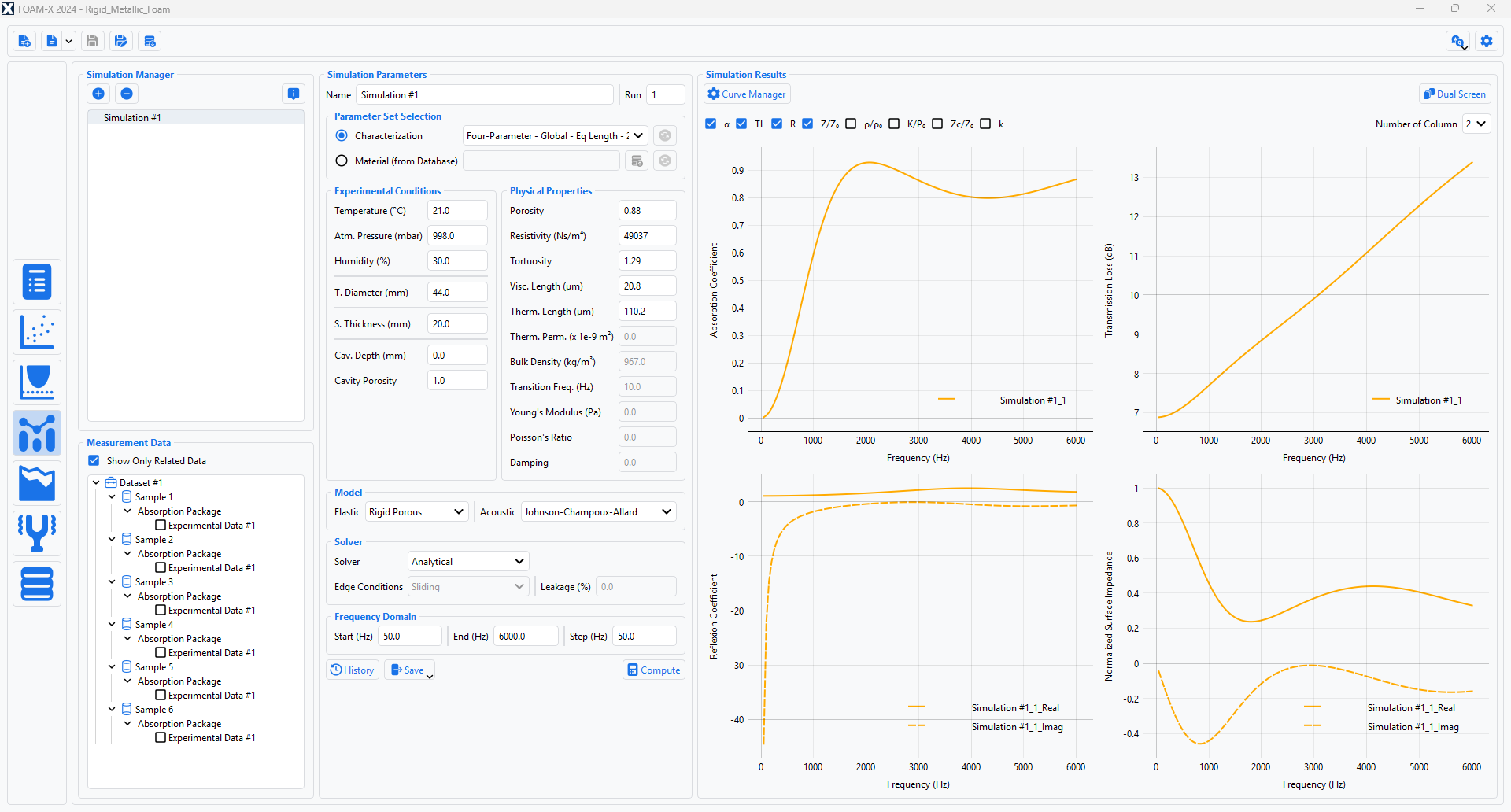
หน้าจอโมดูล Simulation ของ FOAM-X: ช่องสภาพการทดลองและค่าทางกายภาพตรงกลาง เลือกแบบจำลอง Rigid Porous กับ Johnson-Champoux-Allard และตัวแก้สมการ Analytical ด้านขวามีกราฟสี่ช่อง คือสัมประสิทธิ์การดูดซับ การสูญเสียการส่งผ่าน สัมประสิทธิ์การสะท้อน และอิมพีแดนซ์ผิวที่ทำให้เป็นบรรทัดฐานFOAM-X Simulation module: experimental conditions and physical properties in the middle, Rigid Porous with Johnson-Champoux-Allard selected as the model and an Analytical solver; four graphs on the right showing absorption coefficient, transmission loss, reflection coefficient and normalized surface impedance
Simulation: ในภาพ ชุดพารามิเตอร์จากขั้น Characterization ถูกนำมาคำนวณสำหรับตัวอย่างความหนา 20 มม. ในท่อ 44 มม. ด้วยแบบจำลอง Johnson-Champoux-Allard แล้วแสดงค่าการดูดซับ (α), TL, สัมประสิทธิ์การสะท้อน และอิมพีแดนซ์ผิว เป็นวิธีดูว่าวัสดุเดียวกันจะเป็นอย่างไรเมื่อเปลี่ยนเงื่อนไข คลิกเพื่อดูภาพขนาดเต็มSimulation: in the screenshot, a parameter set from the Characterization step is used to calculate a 20 mm thick sample in a 44 mm tube with the Johnson-Champoux-Allard model, showing absorption (α), TL, reflection coefficient and surface impedance. It is a way to see how the same material behaves when the conditions change. Click to view full size ภาพ: MecanumImage: Mecanum
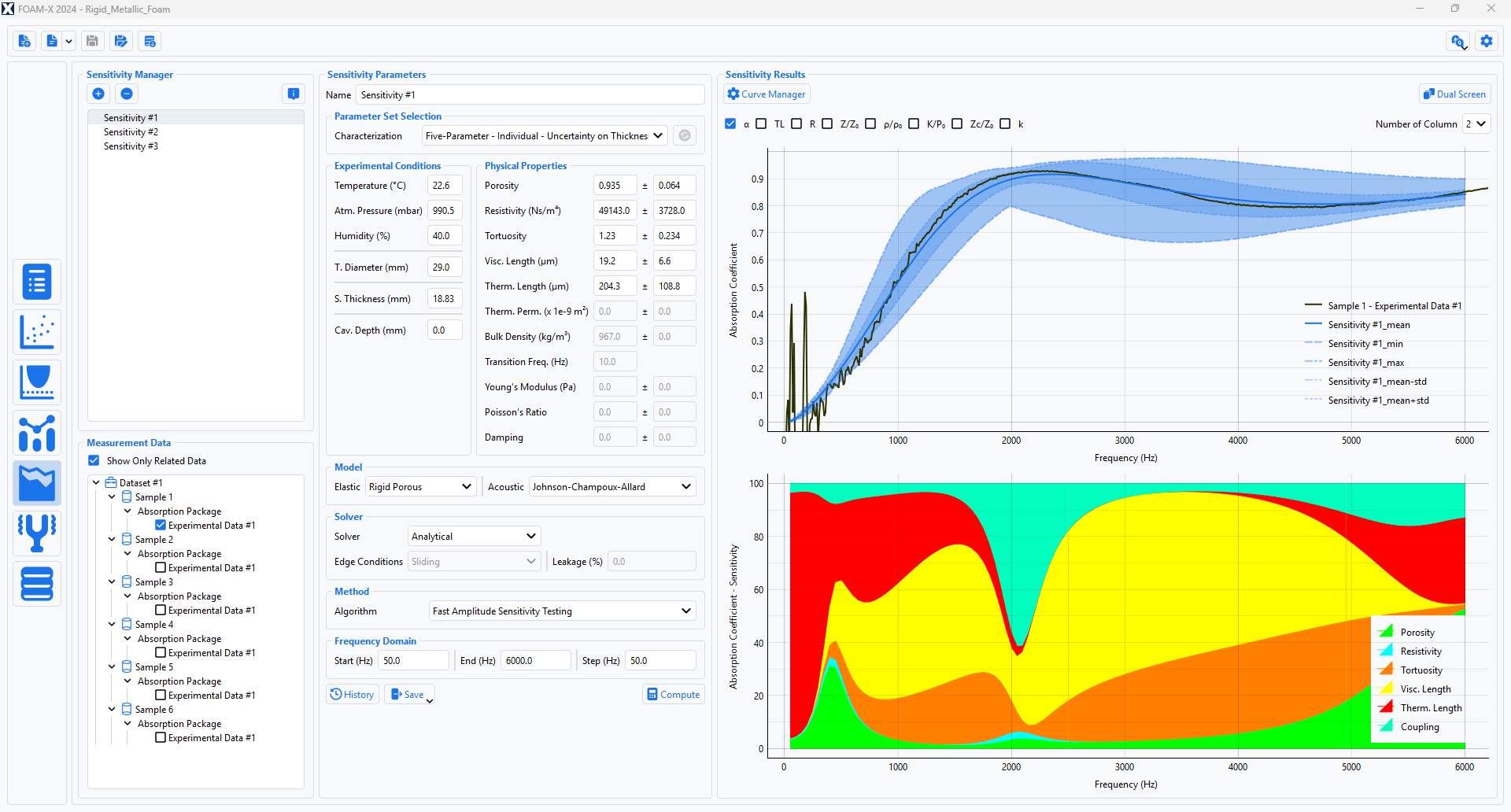
หน้าจอโมดูล Sensitivity ของ FOAM-X: ค่าทางกายภาพแต่ละตัวมีค่า ± ช่วงความไม่แน่นอน กราฟบนเป็นเส้นผลวัดกับแถบสีฟ้าแสดงช่วงผลจำลอง กราฟล่างเป็นพื้นที่สีแสดงสัดส่วนอิทธิพลของ porosity, resistivity, tortuosity, viscous length, thermal length และ coupling ตามความถี่FOAM-X Sensitivity module: each physical property with a ± uncertainty, the upper graph showing the measured curve with a blue band of simulated results, the lower graph a coloured area chart of the share of influence of porosity, resistivity, tortuosity, viscous length, thermal length and coupling across frequency
Sensitivity: กราฟบนแสดงว่าช่วงความไม่แน่นอนของพารามิเตอร์ทำให้ค่าการดูดซับกระจายกว้างเท่าไร (แถบสีฟ้า) เทียบกับผลวัด กราฟล่างแสดงว่าในแต่ละความถี่ พารามิเตอร์ใดมีอิทธิพลมากที่สุด ในภาพเลือกอัลกอริทึม Fast Amplitude Sensitivity Testing ข้อมูลนี้ช่วยตัดสินว่าควรวัดค่าใดโดยตรงเพิ่ม คลิกเพื่อดูภาพขนาดเต็มSensitivity: the upper graph shows how widely the parameter uncertainty spreads the absorption (blue band) compared with the measurement; the lower graph shows which parameter has the most influence at each frequency. The screenshot uses the Fast Amplitude Sensitivity Testing algorithm. This helps decide which values are worth measuring directly. Click to view full size ภาพ: MecanumImage: Mecanum

ข้อมูลเข้าและผลลัพธ์Inputs and outputs

FOAM-X ต้องการอะไร และให้อะไร?What does FOAM-X need, and what does it give you?

หัวข้อItemตามที่ Mecanum ระบุAs stated by Mecanum
ข้อมูลเข้าInputsตามที่ Mecanum ระบุAs stated by Mecanumผลวัดจากท่ออิมพีแดนซ์ได้หลายชนิดและหลายรูปแบบ โหลดโครงการจากท่อทั้งชุด หรือวางข้อมูลจาก Excel รวมหลายชุดข้อมูลได้Impedance-tube data from several tube types and geometries; whole impedance-tube projects can be loaded or data pasted from Excel; datasets can be combined
ค่าที่รู้แล้วKnown valuesตามที่ Mecanum ระบุAs stated by Mecanumตรึงค่าที่วัดได้ เช่น σ, φ หรือ α∞ ไว้ระหว่างการหาค่าได้Measured values such as σ, φ or α∞ can be fixed during identification
วัสดุMaterialsตามที่ Mecanum ระบุAs stated by Mecanumรูพรุน เส้นใย แผ่นเจาะรู ผ้าPorous, fibrous, perforated, fabric
ผลลัพธ์Outputsตามที่ Mecanum ระบุAs stated by Mecanumพารามิเตอร์ของแบบจำลอง JCA / JCAL / Biot หรือแบบจำลองแผ่นเจาะรูและผ้า พร้อมการประเมินความไม่แน่นอน และการวิเคราะห์ความไวตามความถี่JCA / JCAL / Biot, perforated-plate or fabric model parameters, with uncertainty quantification and frequency-dependent sensitivity analysis
โครงการProjectตามที่ Mecanum ระบุAs stated by Mecanumเก็บข้อมูลดิบ พารามิเตอร์ ผลทำนาย และบันทึกไว้ด้วยกันKeeps raw data, parameters, predictions and notes together
ส่งต่อExportตามที่ Mecanum ระบุAs stated by MecanumNOVA, VA One, COMSOL, Hexagon และแบ่งปันกับเพื่อนร่วมงานNOVA, VA One, COMSOL, Hexagon, and sharing with colleagues
ระบบปฏิบัติการ ราคา ลิขสิทธิ์OS, price, licenceตามที่ Mecanum ระบุAs stated by MecanumMecanum ไม่ได้เผยแพร่Not published by Mecanum

เหมาะกับใคร และควรรู้อะไรก่อนเลือกWho it is for, and what to check first

ใครควรใช้ FOAM-X?Who should use FOAM-X?

  • ทีมวิจัยและพัฒนาวัสดุดูดซับเสียง ที่ต้องการค่าทางกายภาพเพื่อเปรียบเทียบและปรับสูตรวัสดุR&D teams developing sound-absorbing materials who need physical values to compare and refine formulations
  • วิศวกรที่จำลองชุดวัสดุหลายชั้นหรือระบบ vibro-acoustic และต้องการพารามิเตอร์วัสดุที่มาจากผลวัดจริงEngineers simulating multilayer treatments or vibro-acoustic systems who need material parameters based on real measurements
  • ห้องปฏิบัติการและมหาวิทยาลัยที่มีท่ออิมพีแดนซ์ และต้องการต่อยอดจากกราฟ α ไปสู่แบบจำลองวัสดุLaboratories and universities with an impedance tube who want to go beyond α curves to material models
ก่อนตัดสินใจ: สิ่งที่ควรเตรียมและสอบถามBefore you decide: what to prepare and ask
  • ข้อมูลที่มีอยู่: ใช้ท่ออิมพีแดนซ์ขนาดใด วัดได้ย่านความถี่ใด และบันทึกข้อมูลในรูปแบบใดYour data: which impedance-tube diameter, which frequency range, and in what format the data are stored
  • ชนิดวัสดุ: โฟม ใย แผ่นเจาะรู หรือผ้า และโครงวัสดุมีผลต่อเสียงหรือไม่ (ถ้ามี ต้องใช้แบบจำลอง Biot และค่าทางกล)Material type: foam, fibre, perforated plate or fabric, and whether the frame affects the sound (if so, you need the Biot model and mechanical values)
  • ค่าที่วัดตรงได้: มีเครื่องวัด airflow resistivity หรือค่าอื่นหรือไม่ ยิ่งตรึงค่าได้มาก ผลยิ่งเชื่อถือได้Direct values: do you have an airflow resistivity meter or other instruments? The more values you can fix, the more reliable the result
  • ปลายทางของข้อมูล: จะใช้พารามิเตอร์ใน NOVA หรือซอฟต์แวร์อื่น เช่น VA One หรือ COMSOLWhere the data goes: NOVA, or other software such as VA One or COMSOL

GET BEST SOUND ช่วยอะไรได้: ให้คำปรึกษาว่าเครื่องมือวัดและซอฟต์แวร์ชุดใดเหมาะกับวัสดุและคำถามของคุณ ประสานข้อมูลผลิตภัณฑ์กับ MecanumHow GET BEST SOUND helps: advice on which instruments and software fit your material and your question, coordination of product information with Mecanum.

คำถามที่พบบ่อยFAQ

คำถามที่พบบ่อยเกี่ยวกับ FOAM-XFrequently asked questions about FOAM-X

FOAM-X ต้องใช้ข้อมูลอะไร?What data does FOAM-X need?

ข้อมูลหลักคือผลวัดจากท่ออิมพีแดนซ์ Mecanum ระบุว่าโหลดโครงการจากท่อทั้งชุดหรือวางข้อมูลจาก Excel ได้ และรวมข้อมูลจากท่อหลายชนิดได้ ค่าที่วัดตรง เช่น airflow resistivity ช่วยให้ผลเชื่อถือได้มากขึ้นThe main input is impedance-tube data. Mecanum says whole tube projects can be loaded or data pasted from Excel, and data from several tube types can be combined. Directly measured values such as airflow resistivity make the result more reliable.

ใช้ข้อมูลจากท่ออิมพีแดนซ์ของระบบอื่นได้ไหม?Can I use data from another impedance-tube system?

Mecanum กล่าวถึงการวางข้อมูลจาก Excel แต่ไม่ได้ระบุความเข้ากันได้กับระบบท่อของผู้ผลิตรายอื่นโดยเฉพาะ ส่งตัวอย่างข้อมูลมาให้เราตรวจสอบกับ Mecanum ได้Mecanum mentions pasting data from Excel but does not state compatibility with specific third-party tube systems. Send us a sample of your data and we can check with Mecanum.

FOAM-X หา Young's modulus จากท่ออิมพีแดนซ์อย่างเดียวได้ไหม?Can FOAM-X find Young's modulus from impedance-tube data alone?

หน้าทางการของ Mecanum ไม่ได้ระบุเช่นนั้น E, ν และ η อยู่ในรายการพารามิเตอร์ของ FOAM-X แต่ Mecanum มีเครื่องวัดทางกลแยกต่างหากสำหรับค่าเหล่านี้ ควรยืนยันวิธีกับ Mecanum ก่อนวางแผนงานที่ต้องใช้แบบจำลอง BiotMecanum's official pages do not say so. E, ν and η appear in FOAM-X's parameter list, but Mecanum makes a separate mechanical analyzer for these values. Confirm the method with Mecanum before planning work that needs the Biot model.

พารามิเตอร์จาก FOAM-X ใช้กับซอฟต์แวร์อื่นได้ไหม?Can FOAM-X parameters be used in other software?

Mecanum ระบุการส่งออกไปยัง NOVA, VA One, COMSOL และ HexagonMecanum lists export to NOVA, VA One, COMSOL and Hexagon.

ทำไมค่าที่ได้จึงมีช่วง ± ?Why do the results come with a ± range?

เพราะผลวัดมีความคลาดเคลื่อน และพารามิเตอร์บางตัวมีผลน้อยในย่านความถี่ที่วัด FOAM-X ประเมินความไม่แน่นอนและวิเคราะห์ความไว เพื่อบอกว่าค่าใดเชื่อถือได้มากหรือน้อยBecause measurements have errors and some parameters have little influence in the measured range. FOAM-X quantifies uncertainty and analyses sensitivity to show which values are well or poorly determined.

ค่า α จากท่ออิมพีแดนซ์ใช้แทนค่าจากห้องก้องได้ไหม?Can impedance-tube α replace reverberation-room values?

ไม่ได้โดยตรง ท่อวัดเสียงที่ตกกระทบตั้งฉาก ส่วนห้องก้องวัดเสียงจากทุกทิศทางบนชิ้นงานขนาดใหญ่ อ่านเพิ่มที่ การสะท้อน การดูดซับ และการส่งผ่านเสียงNot directly. The tube measures sound arriving straight on, while a reverberation room measures sound from all directions on a large specimen. Read more in Reflection, absorption and transmission.

ราคาและรูปแบบลิขสิทธิ์เป็นอย่างไร?What about price and licensing?

Mecanum ไม่ได้เผยแพร่ราคาและรูปแบบลิขสิทธิ์Mecanum does not publish prices or licence types.

แหล่งข้อมูลทางการและการตรวจทานOfficial sources and review

ข้อมูลตรวจสอบกับเว็บไซต์ทางการของ Mecanum เมื่อ 26 กันยายน 2026 เนื้อหาเขียนใหม่โดย GET BEST SOUND ไม่ได้คัดลอกจาก Mecanum ภาพหน้าจอเป็นตัวอย่างของ Mecanum ไม่ใช่ผลวัดของ GET BEST SOUNDChecked against Mecanum's official website on 26 September 2026; text written by GET BEST SOUND, not copied from Mecanum. Screenshots are Mecanum examples, not GET BEST SOUND measurements.

สอบถามเรื่อง NOVA / FOAM-XAsk about NOVA / FOAM-X

มีตัวอย่างวัสดุหรือผลวัดจากท่ออิมพีแดนซ์ และอยากรู้ว่าจะได้พารามิเตอร์ที่ใช้ออกแบบต่อได้อย่างไร เล่าให้ทีมวิศวกร GET BEST SOUND ฟังได้Have a material sample or impedance-tube data and want to know how to get parameters you can design with? Tell the GET BEST SOUND engineers about it.

โทรศัพท์Phone062-195-1909
อีเมลEmailgetbestsoundthailand@gmail.com
Line Official@x2525